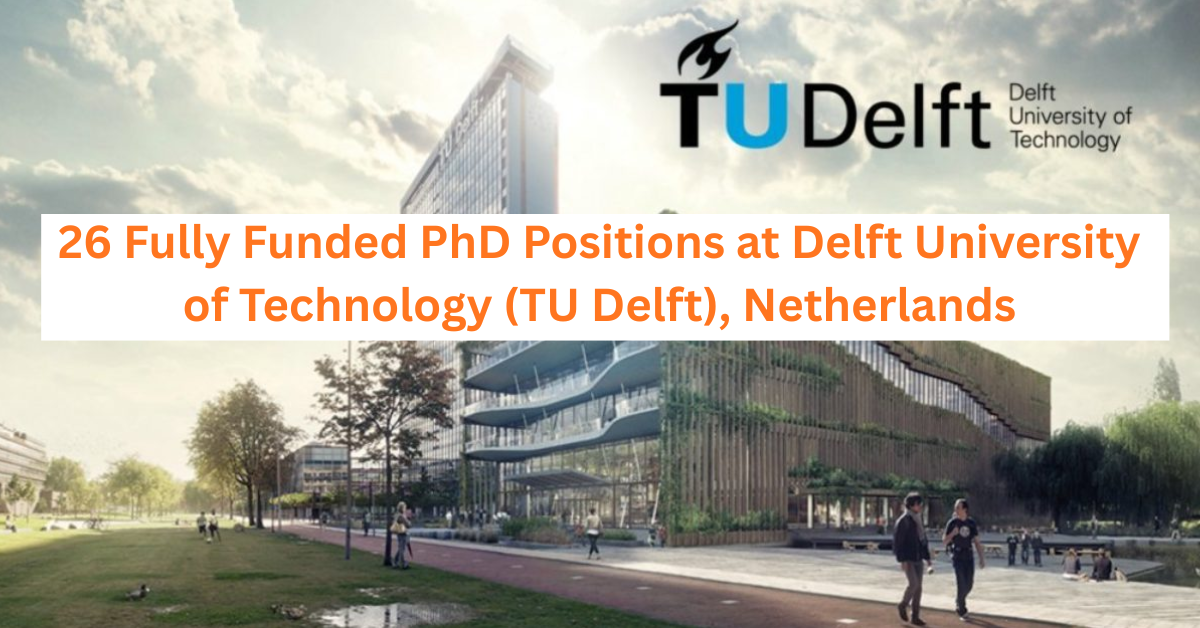
Delft University of Technology (TU Delft), Netherlands invites online Application for number of Fully Funded PhD Degree at various Departments. We are providing a list of Fully Funded PhD Programs available at Delft University of Technology (TU Delft), Netherlands.
Eligible candidate may Apply as soon as possible.
(01) PhD Degree – Fully Funded
PhD position summary/title: PhD Position on Responding to Values and Value Tensions in Transitions in the Built Environment
This PhD position is part of the NWO-funded AMBITIONS project, a transdisciplinary consortium in the built environment. Together, we explore how value-driven tools can help practitioners and policymakers navigate value tensions that arise at the intersection of multiple transitions. One of the aims of the project is to develop a systemic view of values and maps the values and value relationships (conflicts and complementarities) within and between public values articulated in the transitions relevant to the built environment with an emphasis on the energy transition, the transition to a circular economy and the preventive public health transition.
As part of you research, you will carry out the following research activities:
- Develop a conceptual framework that helps to explicate how policymakers can respond to values and values relationships found at the regional and local level with respect to transitions in the built environment;
- Empirically apply this framework and carry out interviews with key stakeholders in and outside the consortium;
- Do a comparative analysis of policy responses to public values and value conflicts in various transitions in the built environment to identify best practices. The results will be laid down in a policy brief for policymakers.
Your research will be part of Work Package 1 of the AMBTIONS projects. This WP focuses on the national, policy-making level of transitions whereas other WPs focus more on the regional and local level. WP 1 aims to understand 1) how values are systematically connected to each other, and 2) how policy makers can identify and respond to public values and value relationships. The focus of your research will be on the second objective. The first objective will be investigated by a postdoc at the Utrecht University (UU). We aim for a close collaboration between TU Delft and UU in WP 1. A description of the AMBITIONS project is available on request.
You will join the section Ethics and Philosophy of Technology at the Faculty of Technology, Policy and Management, You will collaborate with researchers at the TU Delft Faculty of Industrial Engineering, Utrecht University, University of Twente, and Avans Hogeschool. Together, you will be part of an active network of leading researchers in Design for Values, the Built Environment, and Transition Studies.
Deadline : 8 March 2026
(02) PhD Degree – Fully Funded
PhD position summary/title: PhD Position on Multi-Carrier Energy Hubs for Horticulture with Positive Grid Impact
The energy transition requires the deployment of large amounts of renewable power capacity and the electrification of many energy end uses. However, this increases the fluctuations of demand and generation the system must deal with, and exacerbates grid congestion. Multi-Carrier Energy Hubs (MC-EHs), where multiple energy generation, conversion, and storage technologies across diverse carriers integrate smartly and locally, show promise for overcoming such barriers. They enable circumventing grid congestion while offering flexibility to the large-scale system.
In the Netherlands, the sector with the highest potential for deploying innovative MC-EHs is that of greenhouse horticulture. Via its combined heat-and-power (CHP) plants used for electricity, heat and CO2 demands, it provides 11% of the yearly national electricity supply and 10% of the dispatchable power capacity that balances the increasing variability of demand and renewables on the grid. However, the energy transition requires horticulture to shift from fossil CHPs to sources like geothermal and solar. If this occurs, the sector would turn from a flexible net electricity producer into an inflexible net electricity consumer. The grid would lose flexible CHPs and need new, ad-hoc dispatchable capacity investments, as already occurring in some areas. Instead, horticulture has the potential to solve and accelerate the Dutch energy transition by shifting to innovative MC-EHs designed from the start to benefit not only local greenhouse needs but also to act as system buffers that support large-scale renewable integration and mitigate grid congestion. We call this a ‘system-positive’ MC-EH.
In this PhD trajectory, we focus on developing the methods and tools required to support decision-making during this transition towards ‘system-positive’ MC-EH, with application to greenhouse horticulture. We want to address this challenge in various stages. First, by supporting the design of a first-of-its-kind system-positive MC-EH for a real-life pilot in collaboration with real-world industrial partners and stakeholders. Second, by generalising the methods so they can be applied to any horticulture system in the Netherlands and enabling the scale-up of the concept to the whole system.
To achieve the above goals, you will develop cutting-edge energy system design methods, building on tools and methods that our team excels at, such as open-source energy system modelling frameworks and Modelling to Generate Alternatives (MGA), and combining them with techniques from AI and other fields to ease computation and ensure robust assessments.
This PhD position is funded under the SPROUT project, funded by RVO. You will work closely with other researchers at TU Delft (such as Koty McAllister, from Mechanical Engineering), Wageningen University & Research, and Leiden University, as well as our industrial partners: Division Q, eFuelution, Resourcefully and Westland Infra.
You will work more closely with Francesco Lombardi and will be embedded in the Energy & Industry section, where you will build on existing expertise and models on energy system optimisation and MGA. You will join a lively community of internationally renowned interdisciplinary energy researchers in the Department of Engineering Systems and Services at TU Delft. Our faculty hosts a diverse group of people from different countries and disciplines, and we welcome candidates who contribute to and enjoy this diversity.
Deadline : 26 February 2026
View All Fully Funded PhD Positions Click Here
(03) PhD Degree – Fully Funded
PhD position summary/title: Two PhD Positions in AI-Based Discovery of Shared Mechanisms in Cancer and Neurological Disorder
Cancer and neurological diseases pose major challenges to modern healthcare. Despite their apparent differences, these conditions share striking cellular-level similarities, including altered cell–cell communication, immune involvement, and high inter-patient heterogeneity. Epidemiological studies even suggest inverse relationships between cancer and neurodegenerative disorders, hinting at shared—but counteracting—biological mechanisms that remain largely unexplored.
TU Delft, as a key partner in the national ADORE programme, offers two fully funded PhD positions focused on developing innovative computational and AI-based approaches to uncover these mechanisms. PhD candidates will work closely with experimental and clinical partners to translate computational insights into biological and clinical understanding.
Research Focus
The projects aim to develop advanced computational methods for analyzing large-scale, multimodal biomedical data—including single-cell and spatial omics, imaging, and clinical datasets. Key objectives include modeling cellular heterogeneity, mapping cell–cell interactions in diseased tissue, and identifying novel biomarkers and therapeutic targets.
Key Research Topics:
- Multimodal data integration for single-cell and spatial omics
- Deep learning and representation learning to model cellular states and interactions
- Explainable AI for biomarker discovery and patient stratification
- Cross-disease modeling to uncover shared mechanisms in cancer and neurological disorders
The primary emphasis is on method development, guided by real-world biological and clinical questions arising from the ADORE consortium.
Deadline : 9 February 2026
(04) PhD Degree – Fully Funded
PhD position summary/title: PhD Position Optimzation of Interdependent Telecom and Urban infrastructures
The functioning of cities depends more than ever on urban infrastructures like transportation networks, power grids, water networks, Internet of Things sensors, and analytics platforms that gather data from those infrastructures, as well as telecommunications networks. To fully support the operation of cities, telecommunications networks also need to evolve, offering, e.g., ubiquitous connectivity and decentralised data-center capabilities to optimize urban performance. This project aims to explore how telecommunications networks and urban infrastructures interdepend and co-evolve, and to identify network designs that can further enhance global telecommunications and urban performance.
This exciting PhD project presents several scientific challenges, including developing advanced models for interdependent or co-evolving telecom and urban infrastructures driven by real-world data, surpassing state-of-the-art synthetic models; collecting and integrating diverse datasets, including entity matching; and combining expertise from, e.g., network data science and telecommunications to address the above modeling and design questions.
You will be part of a leading team in network data science within the Multimedia Computing Group (MMC) in Computer Science. We share a drive to understand and optimize complex systems ranging from social, technical, to economic systems. The supervision team consists of Dr. Huijuan Wang from MMC and Dr. Eric Smeitink from KPN and the Network Architectures and Services Group.
The PhD position is part of NExTWORKx, the strategic partnership between the telecom and ICT service provider KPN and Delft University of Technology. Curious to learn more about the project? Feel free to visit our website, where you’ll also find other exciting PhD opportunities related to this collaboration.
In your role, you will collaborate with partners and external collaborators from, e.g., NExTWORKx and other projects on critical infrastructures. Fostering an inspiring, friendly, and supportive environment, we meet regularly, share ideas and knowledge, and you will receive the support you need to evolve as a scientist.
Deadline : 28 February 2026
(05) PhD Degree – Fully Funded
PhD position summary/title: PhD Position Algebraic and Topological Dynamics
M(atchbox)-manifolds are natural generalizations of Euclidean manifolds. While the one-dimensional case is relatively well understood, higher-dimensional m-manifolds remain largely unexplored.The focus of your research will be a special class of m-manifolds with additional symmetries that support rich dynamical behavior. These spaces were recently identified as particularly promising: they have now been topologically classified under the assumption of a free abelian group action, which opens the door to applications in higher-dimensional tiling theory and raises new questions on how the abelian condition may be relaxed.
You will collaborate closely with PhD students and postdocs at TU Delft and Leiden University who are working on other aspects of m-manifolds and dynamics. You will join the Applied Probability group at TU Delft, an active research environment spanning a wide variety of pure and applied topics.
The supervision team consists of Robbert Fokkink (TU Delft) and Olga Lukina (Leiden University). This PhD position is part of the NWO project 3-FOLDS, led by Olga Lukina (Leiden University).
Deadline : 31 Jan 2026
Polite Follow-Up Email to Professor : When and How You should Write
Click here to know “How to write a Postdoc Job Application or Email”
(06) PhD Degree – Fully Funded
PhD position summary/title: PhD Position Application of Planetary Radio Interferometry and Doppler Experiment
We are seeking a highly motivated PhD candidate to strengthen the scientific exploitation of PRIDE (Planetary Radio Interferometry and Doppler Experiment) observations by developing and applying open, reproducible analysis pipelines for deep-space mission tracking. You will be embedded in the PRIDE collaboration and contribute directly to enhancing the scientific return of past, current, and upcoming planetary missions, including the Jupiter Icy Moons Explorer (JUICE).
A core element of the position is the use and extension of the TU Delft Astrodynamics Toolbox (Tudat) open-source astrodynamics toolbox for state estimation and orbit/parameter determination, enabling rigorous fusion of PRIDE observables with conventional radiometric tracking data. Your work will bridge radio data analysis, planetary science, and software development, and will directly contribute to improving the accuracy, traceability, and accessibility of advanced orbit determination methods for the broader community.
Deadline : 6 February 2026
(07) PhD Degree – Fully Funded
PhD position summary/title: PhD in N-Dimensional Point Cloud Data Management for Adaptive Meshfree Urban Wind Simulation
Accurate urban wind simulations are vital for understanding microclimate, urban heat, and pollutant dispersion. Yet conventional Computational Fluid Dynamics (CFD) workflows rely on watertight geometric models and volumetric meshes that are slow, complex, and costly to produce. Within the POINT-TWINS project, you will help transform this field by enabling meshfree simulations directly on massive, real-world airborne LiDAR point clouds.
Nationwide LiDAR datasets contain billions of points and are increasingly enriched with additional time and scale dimensions for dynamic, space- and time-adaptive simulations. Managing this n-dimensional data efficiently is a central challenge. In your PhD research, you will explore advanced data structures, Spatial and non-spatial Database Management Systems, and high-performance computing strategies to enable fast, scalable handling of these datasets. You will also investigate deep learning methods for local data augmentation and adaptive point density control, addressing the anisotropy and uneven sampling typical of urban LiDAR.
You will work on a four-year doctoral project jointly supervised by Dr. Azarakhsh Rafiee, Prof. Peter van Oosterom, and Dr. Frits de Prenter. Your home base will be the Department of Architectural Engineering + Technology (Faculty of Architecture and the Built Environment), where you will collaborate closely with a parallel PhD project within the Faculty of Aerospace Engineering focused on meshfree numerical methods. Together, you will work across disciplines to develop the foundations of next-generation urban wind simulation.
The project also offers collaboration opportunities with leading research and industry partners including Fraunhofer ITWM, Dassault Systèmes, ActiFlow, the Dutch Water Boards Association, and the Municipality of The Hague. You will join an international research environment with access to state-of-the-art computational facilities, and you will have ample opportunities for academic growth, conference participation, and scientific publication.
Deadline : 31 January 2026
(08) PhD Degree – Fully Funded
PhD position summary/title: PhD Position on Metamaterials for Flow Control
The MetaWing project explores a new disruptive concept for flow control, first born in classical wave physics: Metamaterials. These are engineered composite structures, invoking dispersive wave phenomena to gain exotic properties that go beyond what is considered possible in Nature. A key property is the bandgap, a range in which waves are suppressed when interacting with the Metamaterial. Our team recently found key evidence of dispersive wave suppression in boundary layers. However, wave-like flow instabilities have key differences from classical waves, forming a new regime of dispersive wave interactions. Thus, the nature of bandgaps in boundary layer flows remains unclear and unexplored.
The main objective of this project is to experimentally develop and use Metamaterial-derived concepts for the control of laminar-turbulent transition on swept wings.
We are seeking an enthusiastic, motivated and skilled PhD candidate to join our team. We will work towards the specific challenge of understanding the formation of bandgaps in swept wing transitional fluid flows and using them to suppress wave-like boundary layer instabilities, thus delaying laminar-turbulent transition.
This PhD position will entail the experimental design, fabrication, and characterisation of Metamaterial prototypes aimed at controlling Crossflow Instabilities forming on swept wings. A range of fabrication facilities available within our laboratory can be used to produce functional prototypes. All prototypes will be characterised for their dynamic and geometrical conformity using in-house methods. Eventually, the prototypes will be exposed to swept wing transitional flows in our windtunnel facilities, (specifically the Low Turbulence Tunnel and/or the Anechoic Vertical Tunnel), to characterise their behavior and understand their influence on boundary layer instabilities. The relevance of this work is not restricted to swept wings but also supports current research in our laboratory whereby suppression of wave-like instabilities in a variety of transitional flows (e.g. 2D boundary layers and laminar separation bubbles) aims to delaying laminar-turbulent transition.
Deadline : 8 Mar 2026
Click here to know “How to Write an Effective Cover Letter”
(09) PhD Degree – Fully Funded
PhD position summary/title: PhD Position on The Delft Laminar Hump
The transition of airflow from laminar to turbulent state is a major contributor to aerodynamic drag and consequently aircraft emissions. Often, unavoidable modifications of the wing surface, such as panel joints or skin deformations decrease the extent of laminar airflow by promoting transition. However, through our research, we showed that this is not always the case. In a recent breakthrough, our team discovered the “Delft Laminar Hump”, a passive smooth surface modification. The proof-of-concept experiments showed the capability of the Hump to create an unprecedented delay of transition, effectively increasing the extent of laminar flow.
The “Running up that Hill” project aims at achieving a clear physical understanding of the interaction between laminar-turbulent transition and surface modifications such as the Delft Laminar Hump. The fundamental and technical outcomes of this work will position Hump-like surface modifications as an enabling technology for curbing environmental emissions of aviation.
In addition to fundamental work, the project is supported by leading aerospace partners such as KLM, DNW, and Deharde as well as by world-leading groups at U. Waterloo, Canada and KTH, Sweden. Opportunities for research stays with these organisations will be available within the project.
We are seeking an enthusiastic and skilled PhD candidate to join our team and work on this exciting project.
The PhD project will encompass theoretical and numerical modelling, necessary to simulate and optimise the effect of surface modifications on swept wing transition. Particular emphasis will be given to adjoint-based optimisation due to the large number of design parameters, versus a small number of cost functions, such as transition location. Flow stability analysis tools available in our team can be used, including Orr-Sommerfeld solvers, linear/non-linear Parabolised Stability Equations and our non-linear Harmonic Navier-Stokes solver. An extensive validation effort will involve high-fidelity Direct Numerical Simulations, in collaboration with the group at KTH Stockholm (Prof. D. Henningson and Dr. A. Hanifi). Research stays at KTH will be covered by the project.
Deadline : 8 Mar 2026
(10) PhD Degree – Fully Funded
PhD position summary/title: Phd Position Computational Design of Patient-Specific Shoulder Implants
Are you passionate about combining computational mechanics, medical imaging, and advanced design optimization to improve people’s lives? Do you want to help shape the next generation of personalized medical implants? Join us in this ambitious, multidisciplinary project at the forefront of computational design, biomechanics, and in silico medicine.
In this PhD project, you will develop the computational foundation for patient-specific shoulder implants with architected internal structures tailored to mechanical needs. Conventional implants are typically designed with generic geometries and stiffness distributions, which can lead to stress shielding, bone resorption, or poor long-term stability. Your challenge is to change this paradigm.
You will create a systematic design framework that uses cutting-edge finite element analysis and topology optimization to design medical implants that are:
- Lightweight yet mechanically robust.
- Optimized for stiffness, strength, and fatigue life.
- Tailored to each patient’s bone geometry and loading environment.
- Manufacturable in biocompatible materials such as titanium.
Leveraging mecial imaging, you will extract patient-specific loading conditions, build high-fidelity finite element models, and optimize the internal architectures that deliver the right mechanical response. The final designed structures will be fabricated and validated through mechanical testing, ensuring clinical and translational relevance.
This PhD position is part of a Marie Skłodowska-Curie Doctoral Network (Horizon Europe). As a MSCA Doctoral Candidate, you will join a cohort of early-stage researchers across several international partner institutions, participate in network-wide schools and workshops, and complete mandatory research secondments abroad. The MSCA programme offers highly competitive employment conditions, structured training, and exceptional international exposure.
Deadline : 29 January 2026
Connect with Us for Latest Job updates
(11) PhD Degree – Fully Funded
PhD position summary/title: PhD Position One Ink
We are seeking a highly motivated PhD candidate with a background in physical chemistry or materials physics to join the project “One Ink to Rule Them All: Integrated Short-Wave Infrared Photodetectors and Light- Emitting Devices Based on III-V Quantum Dots for Wearable Photonic Technologies (ONE INK)”, funded through the PhotonDelta National Growth Fund programme.
ONE INK aims to develop a single printable quantum-dot ink that can both emit and detect short-wave infrared (SWIR) light, enabling a new generation of compact, low-cost, and wearable health-sensing technologies. Using III–V semiconductor nanocrystals, the project will create materials that make it possible to monitor key health markers without invasive blood tests. The ability to print light sources and detectors from one ink directly onto electronics simplifies manufacturing and supports the future of personalised, preventive healthcare. The project will also employ a postdoctoral researcher who will work alongside the PhD candidate.
As a PhD candidate, you will work in the NCFun group of Prof. Arjan Houtepen, with Dr. Tom Savenije as co-supervisor. You will be embedded in a vibrant research environment and closely collaborate with QDI Systems (Groningen) and imec (Leuven). The position is part of a larger, interdisciplinary team working on the synthesis, characterization and device integration of nanomaterials for optoelectronic applications.
Deadline : 28 January 2026
Polite Follow-Up Email to Professor : When and How You should Write
(12) PhD Degree – Fully Funded
PhD position summary/title: PhD Position in Development of Computational Fluid Dynamics Technique for Pointcloud Geometries
Do you enjoy numerical methods and do you want to pursue a PhD in engineering at TU Delft? The POINT-TWINS project aims to develop novel methods that enable Computational Fluid Dynamics (CFD) simulations directly on point cloud representations of urban environments – eliminating the need for traditional meshing and geometry reconstruction.
Urban wind plays a key role in shaping the microclimate of our cities. You’ve likely experienced how certain building configurations can create wind tunnels, resulting in high-speed gusts. Urbanization and global warming further intensify challenges related to thermal comfort and increase the risk of heat islands. Moreover, urban wind strongly influences air quality, as it governs how emissions and pollutants – such as those from traffic – disperse through cities.
To address these concerns in urban planning and building design, engineers and designers rely on Computational Fluid Dynamics (CFD) simulations to predict how wind patterns will be affected by changes in the built environment. However, traditional CFD workflows require watertight surface models and volumetric meshes – steps that are often labor-intensive, error-prone, and technically demanding. This makes urban wind assessments costly and limits their practical applicability. The POINT-TWINS project aims to overcome these limitations through meshfree simulation. This will open the door to scalable, accurate, and more accessible wind assessments across urban environments.
In Geographic Information Systems (GIS), urban environments are increasingly captured using point clouds, which can be acquired efficiently via airborne LiDAR scanning from a drone, helicopter, or small aircraft and in some countries are openly available (e.g., http://ahn2.pointclouds.nl/). In POINT-TWINS, we will develop a novel meshfree CFD method that can enforce boundary conditions directly from point-cloud geometry descriptions, without intermediate surface reconstruction. This is a fundamental shift from traditional CFD techniques and will broaden the applicability of CFD in urban design and planning.
Deadline : 1 February 2026
(13) PhD Degree – Fully Funded
PhD position summary/title: Phd Position Design and Simulation of Patient-Specific Implants Based on External Morphology
The Department of Biomechanical Engineering at TU Delft invites applications for a PhD position aimed at transforming the design of patient-specific orthopedic implants. With a strong foundation in biomechanics, computational modeling, and experimental methods, the BME department provides an ideal environment for developing next-generation regenerative technologies. This project leverages that expertise to create personalized shoulder implants that respond intelligently to individual anatomical and functional demands.
The project will focus on the personalized design of shoulder implants, with particular emphasis on optimizing the external morphology to improve fit, reduce soft tissue irritation, and promote long-term functional outcomes. You will develop a hardware-in-the-loop (HIL) simulation framework that integrates anatomical models and biomechanical data to evaluate implant-tissue interactions. This data-driven platform will enable the design of implants tailored to individual anatomical and loading conditions.
By combining computational modeling with experimental validation, you will explore how implant geometry affects mechanical performance, implant-bone interface adaptation, and osseointegration. The resulting shape-optimized implants will complement structural architectures developed in parallel PhD projects, forming part of a larger, patient-specific bone replacement solution.
This position is embedded in a Marie Skłodowska-Curie Doctoral Network (Horizon Europe), offering advanced training, research mobility, and international secondments. You will join a vibrant network of early-stage researchers and contribute to a new generation of smart, responsive, and clinically effective orthopedic implants.
Deadline : 29 January 2026
(14) PhD Degree – Fully Funded
PhD position summary/title: PhD Position Optical Coherence Tomography for Skin Diagnostics
Skin cancer is one of the most common forms of cancer and its incidence is expected to rise rapidly in the near future. Hence, there is an urgent need for new low cost and high performance screening and diagnostics devices to meet the expected clinical demand. Are you inspired by this challenge and excited to work on the boundary between biomedicine and technology?
In this project you will develop advanced optical coherence tomography (OCT) systems based on novel near infrared supercontinuum (SC) light sources and detectors. The scientific challenge is threefold. First, the OCT system must be optimized in terms of noise and detection efficiency. You will do this based on experiments and physical modeling of SC, detector, and system performance. Second, the OCT system must obtain high-resolution deep-tissue images from clinically relevant samples. You will realize this by applying superresolution and 3D Fourier OCT signal processing techniques. Third, the OCT system must be compact, robust, and cost effective for it to be used it in a clinically relevant setting. In this PhD you work towards making an impact in skin cancer imaging in a collaboration between The Hague University of Applied Sciences and Erasmus Medical Center. As a PhD you are expected to contribute to the team and work closely together with applied physicists, clinicians, and technicians.
Deadline : 1 March 2026
(15) PhD Degree – Fully Funded
PhD position summary/title: PhD Position Additively manufactured biodegradable bone substitutes with tunable degradation
Faculty of Mechanical Engineering, TU Delft — Departments of Precision and Microsystems Engineering (PME) & Biomechanical Engineering (BME)
Are you excited by the idea of engineering next-generation regenerative implants? Do you want to combine additive manufacturing, materials science, biomechanics, and physics- and machine learning-based modeling to create transformative medical solutions? Join us in this ambitious collaboration between the PME and BME departments, and help shape the future of patient-specific bone replacement.
In this PhD project, you will develop biodegradable porous bone substitutes produced through additive manufacturing of metal-ceramic composites. These architected implants will be tailored for mechanical performance and controlled degradation, enabling safe and effective regeneration in load-bearing environments.
Your core challenge is to understand and predict how geometry, material composition, and manufacturing parameters drive quasi-static performance, biodegradation kinetics, and manufacturability. You will employ a combined physics-based and machine-learning modelling approach, supported by in-vitro mechanical and degradation experiments for validation.
The developed porous structures will integrate seamlessly with macro-geometries and topologically optimized architectures from sibling PhD projects, delivering a fully engineered, patient-specific bone-replacement solution.
This PhD position is part of a Marie Skłodowska-Curie Doctoral Network (Horizon Europe). As an MSCA Doctoral Candidate, you will join a vibrant international cohort, participate in network-wide schools and workshops, and pursue mandatory research secondments abroad. The MSCA framework offers exceptional training, mobility, and career-development opportunities
Deadline : 29 January 2026
(16) PhD Degree – Fully Funded
PhD position summary/title: PhD Position on Mechanochemistry for Soft Matter Imaging and Mechanics
Soft matter materials such as polymers and hydrogels are essential building blocks for applications including metamaterials, soft robotics and biomedical implants. In real-world use, materials are often exposed to complex mechanical loads, yet understanding their internal mechanics in real time remains a major scientific challenge. This limits our ability to understand, predict and improve material performance.
In this PhD project, you address that challenge by developing chemistry-based imaging approaches that make mechanical stresses inside soft materials directly visible. By integrating mechanochemistry with advanced imaging and mechanics, the research aims to bridge molecular-scale responses and macroscopic material behaviour. The outcomes of this work will enable new experimental tools for characterising soft matter and contribute to the rational design of high-performance, mechanically robust soft materials.
Deadline : 28 February 2026
(17) PhD Degree – Fully Funded
PhD position summary/title: PhD Broadband Spatial Filter using Photonic Crystal Structures in Spaceborne Optical Instruments
Spatial filtering is essential in space-borne optical instruments to ensure that only well defined, high quality wavefronts contribute to image formation or signal detection. Light collected in space systems often contains unwanted spatial frequencies arising from diffraction, scattering, misalignment, and surface imperfections. Optical beams that exhibit irregular spatial variations of the field amplitude and phase limit the interferometric sensing capability of instruments. Particularly the spatial phase variations make these beams unsuitable for applications involving optical interferometry. Low-pass spatial filtering is an effective technique to suppress high spatial-frequency components of such beams, thereby making their focal-plane profiles smooth and well confined, also reducing their divergence. For space applications such as exoplanetary research and earth observation involving precision optical instruments, therefore, the spatial profile of the beam is needed to be improved.
In this project, you will design and simulate a 2-D photonic structure, based on multi-layer structured coatings as a spatial filter. The optical design seeks to achieve significant improvements in beam quality, addressing the inherent limitations of traditional spatial filtering systems in terms of bulkiness, sensitivity to alignment, and limited performance without compromising optical efficiency. The successful applicant will work on advanced electromagnetic simulation and numerical modelling to achieve optimum design and performance for optical instruments in space environment. The candidate will be part of the Spaceborne Instrumentation section of the Aerospace engineering faculty where they will benefit from the multidisciplinary environment of the faculty.
Deadline : 25 Feb 2026
(18) PhD Degree – Fully Funded
PhD position summary/title: PhD Position “On Thirst and Mirage: Rethinking the Desert”
The majority of the Middle Eastern and North African regions consist of deserts. Deserts are some of the most vulnerable environments, occupying roughly one-fifth of the planet’s land surface and hosting around one-sixth of the global population. In scientific classifications, deserts are characterized as hostile environments with low precipitation and rainfall, compatible with how desertūm (Latin) was perceived negatively as deserted, abandoned, barren and empty. These representations justify or hide the often violent [neo-]colonial, extractive and technocratic practices that deserts have been and are subject to, dominating and disrupting the ecological and cultural delicacies of these territories. Aggravated by climate change and forced migrations, this has resulted in the loss of diverse life forms that rely on and sustain deserts, while also leading to the fading of various forms of literacies connected to these life forms regarding how to coexist with and in deserts.
In such a context, water is the most vital element for life which is preciously scarce or hidden in the deserts. This is while currently most of the water sources in MENA desert regions, whether surface or groundwater, are under growing pressure, violated, conflicted or completely vanishing.
This call invites the applicants to investigate the spatialities and materialities of bodies of water in desert areas which are affected by [neo-]colonial, extractive and technocratic operations or have been impacted by border regimes, conflicts and wars, resulting in ecological disjunction and disembodied resource governance and heightened political tension among communities and states. The aim is not only to unpack the complexities behind such processes but also to seek alternative ways of living in the deserts by re-centering indigenous life forms and biota.
Deadline :30 January 2026
(19) PhD Degree – Fully Funded
PhD position summary/title: PhD Positions Human-Centered, Data-Centric Design of Soundscape Platform for Healthcare Environment
This PhD position is part of the NWO-funded project “Auditory Footprints: A novel soundscape assessment platform for neonatal and paediatric ICUs, which aims to develop the first integrated technological solution that automatically evaluates the perceived quality of the NPICU sound environment and empowers nurses to actively mitigate indoor sound exposure.
This PhD research envisions the design of an NPICU Data Commons, a digital infrastructure empowering nurses, and potential other key stakeholders, to understand and actively shape their working environment through data. Rather than a traditional top-down monitoring system, this platform will enable continuous, nurse-driven investigation where data is collected, explored, and acted upon by and for the nurses themselves. While the platform revolves around soundscape data as its core focus, it will be designed to open up and encourage integration of other forms of contextual and behavioral data (e.g., activity patterns, workflow rhythms) that nurses identify as relevant to understanding their acoustic environment. This vision includes establishing appropriate data governance mechanisms that enable nurses to make informed decisions about data sharing, both within their professional community and potentially with researchers or hospital management. The goal is not simply to create another dashboard, but to facilitate a shift in how nurses can capture, explore, and intervene in their acoustic environment, positioning them as active investigators and designers of their workplace rather than passive recipients of noise measurements.
The research will follow an iterative research and development process characterized by deep, on-site engagement with NPICU nurses throughout all phases. The work begins by defining human-centered design requirements through data probes combined with qualitative research methods including observations, interviews, and user diaries to understand the user journey and establish how occurring sounds relate to nurses’ contextual needs and workflows. Building on these insights, the candidate will co-create the platform prototype through participatory design sessions with nurses, integrating the computational models (developed by another PhD candidate working in parallel on sound modelling) with user experience requirements, while simultaneously collecting and analyzing behavioral data (e.g., activity levels and sleep patterns) and conducting iterative data reflections with stakeholders. This co-creation process will lead to an implementation and evaluation of a live prototype: a server-based, functional digital platform that integrates the soundscape assessment algorithms and can be tested both in controlled environments and in-situ within the actual NPICU context. The candidate will observe, capture and analyze how nurses respond to, appropriate, and potentially transform the platform in their daily practice, with each iteration informing the next phase of development and deepening our understanding of how data-centric tools can meaningfully support healthcare professionals in addressing complex environmental challenges.
Deadline : 28 February 2026
(20) PhD Degree – Fully Funded
PhD position summary/title: PhD position Strengthening learning opportunities for spatial reasoning in upper primary education
Within the NRO-funded project “Make Space!”, we are investigating how the development of spatial skills can be more firmly embedded in the primary school curriculum. In collaboration with Delft University of Technology, Leiden University, and various social partners, we are developing a toolbox that teachers in upper primary school can use to stimulate their students’ spatial thinking. We aim to achieve this through an interdisciplinary approach that combines insights from cognitive psychology and educational sciences with co-creation and teacher professional development.
The consortium is seeking two PhD candidates, one based at Delft University of Technology and the other at Leiden University. The PhD candidates will collaborate closely, but their projects will have different focuses. The Delft project has an educational focus and primarily utilizes qualitative research methods, such as focus groups, co-creation, and lesson study with teachers. The Leiden project has a cognitive psychological focus and primarily uses quantitative research methods to investigate the effect of spatial interventions on students’ spatial and numeracy skills. Together, the two PhD candidates will contribute to a scientifically sound toolbox for spatially challenging education, which will be tested in the classroom. Curious about the vacancy with a Leiden location? Click here .
Deadline :February 28, 2026
(21) PhD Degree – Fully Funded
PhD position summary/title: PhD in Strengthening of Dutch Heritage Buildings with Structural Glass
Older buildings often do not satisfy modern codes when considering lateral loads such as wind forces or updated seismicity hazards. In these cases, buildings need to be retrofitted to ensure they meet safety criteria. Historical buildings are difficult cases because their historical character and value should not be altered; non-invasive and easily-reversible solutions are thus preferred.
With structural glass, a load-carrying layer of glass is added or replaces an existing glass layer in the windows of the building. This makes the walls stiffer and stronger, better capable of counteracting deformations, even those induced by settlements, a common problem of Dutch buildings founded on soft soils. The connection between glass and masonry is designed to give way when forces become too large which the rest of the building may not be prepared to withstand. Instead, the tearing of this interface releases energy that helps dampen and reduce induced forces during earthquake events, for instance. In this manner, the window protects the building from small deformations and large dynamic events.
In the section of Applied Mechanics, we have conducted experiments on a prototype of this solution (see edu.nl/r3wbg). The goal is to apply structural glass to Dutch heritage buildings in need of strengthening, and you can help by:
- advancing the design of the structural glass window considering lateral loads but also aspects such as temperature effects, building physics, constructability, etc.
- performing non-linear computational analyses of the various window elements in combination with typical and specific Dutch heritage buildings, 2D and 3D,
- establishing industry partners and interacting with them to realize an implementable structural glass window solution,
- conducting small experiments to determine glass-building properties and/or helping to acquire funding for larger experiments.
You will work closely with colleagues from the Applied Mechanics group (edu.nl/bv3yt) and other groups at the Faculty of Civil Engineering and Geosciences TU Delft and engage with a diverse team of national and international partners. This PhD project is linked to TU Delft’s contributions to understanding building damage due to quasi-static and dynamic ground movements and carries substantial societal relevance and usefulness. Collaborations with government institutions are ongoing.
Deadline : 8 February 2026
(22) PhD Degree – Fully Funded
PhD position summary/title: PhD Positions on Quantum Photonics with Color Centers
Are you motivated to discover the qubits that build the quantum information processing machines of the future? Do you want to embed qubits in scalable systems and help bring quantum technology to real-world applications? We are seeking PhD researchers to work in the exciting field of integrated quantum photonics!
Color centers have proven to be one of the most fruitful platforms in the quantum information era, enabling breakthroughs such as memory-enhanced quantum communication, entanglement-based quantum networks, long-term quantum information storage, and complex quantum simulations. While these demonstrations point to a wide range of applications, critical challenges regarding color center physics and their large-scale integration into systems remain untackled.
As a PhD student in the Errando-Herranz’s group, you will work towards addressing the main challenges in the field by working on experiments involving integrated photonics, single photon detectors, and color center qubits. You will focus on device design and characterization, delving into the complex physics of color centers, and developing technology based on integrated photonic circuits and single-photon detectors for quantum and classical applications.
You will be part of a team of talented PhD students within the ERC Starting Grant DISQOVER and/or other EU and NL projects, collaborating with top European and international teams. You will also have full access to the group’s state-of-the-art measurement setups for magneto-optic spectroscopy at room and cryogenic temperatures down to 40 mK.
Deadline : 1 February 2026
(23) PhD Degree – Fully Funded
PhD position summary/title: PhD Position Cryo-CMOS Readout Circuit for Single-Photon Detectors for Quantum Computers
Quantum computers promise to solve problems intractable by classical digital computers, while quantum sensors can offer unprecedented accuracy and sensitivity in detecting very small quantities. However, quantum devices typically operate at cryogenic temperatures, thus requiring long, bulky, and unreliable wires to connect to their room-temperature control electronics. This wiring bottleneck hinders the system’s scalability and performance. As a PhD student in Electrical Engineering at TU Delft, you will overcome this bottleneck by building the cryogenic interface for future quantum systems.
In our group, we have pioneered the use of CMOS integrated circuits operating at cryogenic temperatures (cryo-CMOS). We adopt standard CMOS technologies to leverage their large-scale integration, as required for future large-scale quantum computers and cryogenic sensors, and to enhance their performance. CMOS devices are functional at temperatures as low as 4 K and below, but their behavior differs significantly from that at room temperature, including an increased threshold voltage, a higher driving current, and lower thermal noise. The challenges lie in exploiting the advantages of cryogenic operation, such as the lower thermal noise, while circumventing device non-idealities by inventing innovative circuit architectures and systems that can outperform the state-of-the-art. Although we have demonstrated several high-performance cryo-CMOS circuits and systems over the last decade, your challenge will be to demonstrate new functionalities and push the boundaries of circuit performance and knowledge.
In this project, you will develop the cryogenic interface for extremely sensitive cryogenic single-photon detectors, the Superconducting Nanowire Single Photon Detectors (SNSPDs) developed by our partner Single Quantum. Thanks to their superior performance, those sensors are currently used for the readout of quantum bits (qubits) in the photonic quantum computers developed by our partner Quix. However, commercially available SNSPD systems are limited to a maximum of 48 channels, while tens of thousands of channels are needed to enable large-scale quantum computation with practical applications. Although it is in principle possible to reliably fabricate a large number of detectors and connect the large number of required optical fibers to the quantum computer, a strict bottleneck in the number of electrical interconnects between the cryogenic photon detectors and their room-temperature read-out hinders the system scalability. To overcome this bottleneck, you will demonstrate a scalable area-efficient ultra-low-power cryogenic electronic interface for single-photon detectors that will enable the readout of 1000+ channels within the cooling constraints of existing cryogenic refrigerators.
You will design the full read-out chain exceeding state-of-the-art performance and able to address 1000+ channels all within a very strict power budget. The read-out will comprise low-noise amplifiers, time taggers to measure the photon arrival time, and an efficient data transfer to the room-temperature controller. Over the course of your PhD, you will devise innovative system architectures and circuits, design several prototypes of cryo-CMOS circuits, tape them out in advanced CMOS technologies, and characterize the resulting prototypes in our advanced cryogenic electrical characterization laboratory.
Your results will advance the state-of-the-art in cryo-CMOS circuit design and will result in presentations at top conferences for advances in integrated circuits and publications in high-impact scientific journals. Your cryo-CMOS readout will be integrated into the readout system for photon-based quantum computers developed by TU Delft and our industrial partners, thus achieving a real impact in the field of quantum technologies.
Deadline : February 8, 2026
(24) PhD Degree – Fully Funded
PhD position summary/title: PhD Position on ‘Agent-Based Modeling for Empowering Citizen Collectives in Societal Transitions
This PhD position focuses on using agent-based modeling (ABM) to explore the lifecycle of community intiatives, as part of the ECCO project ((Empowering Citizen COllectives in societal transitions).
ECCO investigates how citizen collectives—grassroots organizations formed by citizens working together on shared goals—can become powerful drivers of societal change in areas like housing, work, income, and sustainability. You’ll explore how these collectives can partner effectively with governments to address today’s most pressing challenges, from climate change to social inequality.
This PhD research will develop adaptive institutional design principles for citizen collectives (CCs) throughout their lifecycle. You’ll use cutting-edge AI-powered agent-based modeling combined with Large Language Models to create context-sensitive governance frameworks that address different developmental stages of CCs.
Your role: You’ll conduct three in-depth case studies, develop sophisticated simulation models, and co-create practical tools with CCs through interactive workshops. Your research will transform theoretical governance principles into actionable, evidence-based recommendations that CCs can immediately apply.
Deadline : 13 February 2026
(25) PhD Degree – Fully Funded
PhD position summary/title: PhD Identifying Collective Values Amongst Housing Collectives for Sustainability Transitions
This position is part of the NWO-funded ECCO (Empowering Citizen COllectives in societal transitions) project, a groundbreaking collaboration between five leading Dutch universities. ECCO investigates how citizen collectives—grassroots organizations formed by citizens working together on shared goals—can become powerful drivers of societal change in areas such as housing, work, income, and sustainability. The project examines how these collectives can partner effectively with governments to address pressing challenges, from climate change to social inequality. Within ECCO, 11 PhD researchers will form a cohort working collaboratively across disciplines and institutions. This particular position will be hosted at the Department of Management in the Built Environment (MBE), Faculty of Architecture and the Built Environment, TU Delft.
Deadline : 15 February 2026
(26) PhD Degree – Fully Funded
PhD position summary/title: PhD Position Discrete Mathematics: Extremal Problems in Finite Geometry
The Discrete Mathematics and Optimization group within the Delft Institute of Applied Mathematics at TU Delft is offering a full-time PhD position in the area of finite geometry.
Finite geometry studies finite structures that satisfy axioms of classical geometrical spaces such as the Euclidean and projective spaces. In this project, by developing novel combinatorial, algebraic, and probabilistic tools, you will work on resolving fundamental extremal problems in the area of finite geometry. These problems have connections to Ramsey theory, coding theory, and spectral graph theory.
The PhD will be supervised by Anurag Bishnoi.You will have the opportunity to collaborate with Postdocs, PhD candidates, and other faculty members of the research group. You will also get to work with various collaborators of Anurag Bishnoi.
Besides carrying out mathematical research and preparing scientific publications, you will be expected to actively participate in seminars and discussions within the department, as well as present your work at both national and international conferences and workshops. You will also carry out minor teaching tasks (at most 15% of your time). Teaching and communication will be in English. If desired, you can take Dutch language courses offered by the TU Delft Language Center.
Deadline : 1 Feb 2026
About Delft University of Technology (TU Delft), Netherlands –Official Website
Delft University of Technology, also known as TU Delft, is the oldest and largest Dutch public technical university. Located in Delft, Netherlands, it is consistently ranked as one of the best universities in the Netherlands, and as of 2020 it is ranked by QS World University Rankings among the top 15 engineering and technology universities in the world.
With eight faculties and numerous research institutes, it has more than 26,000 students (undergraduate and postgraduate) and 6,000 employees (teaching, research, support and management staff).
The university was established on 8 January 1842 by William II of the Netherlands as a Royal Academy, with the primary purpose of training civil servants for work in the Dutch East Indies. The school expanded its research and education curriculum over time, becoming a polytechnic school in 1864 and an institute of technology (making it a full-fledged university) in 1905. It changed its name to Delft University of Technology in 1986.
Dutch Nobel laureates Jacobus Henricus van ‘t Hoff, Heike Kamerlingh Onnes, and Simon van der Meer have been associated with TU Delft. TU Delft is a member of several university federations, including the IDEA League, CESAER, UNITECH International and 4TU.
Disclaimer: We try to ensure that the information we post on VacancyEdu.com is accurate. However, despite our best efforts, some of the content may contain errors. You can trust us, but please conduct your own checks too.
Related Posts