Academic life doesn’t come with a time clock. There’s no siren that tells you to stop reading, stop analyzing, or stop revising that manuscript for the fourth time this week. Most researchers just keep going until the brain quietly hands in its resignation.
If you’re a PhD student, postdoc, or faculty applicant, you already know the feeling. You’ve read the papers. You’ve run the analysis. You’ve written the cover letter for the third faculty search this month. And somewhere in there, your focus started slipping without you noticing.
Here’s the part nobody tells you in grad school: productivity in research isn’t only about working harder. It’s about recovering smarter.
Most researchers try to recover by checking LinkedIn, scrolling social media, reading the news, or opening emails “just for a second.” Unfortunately, none of these actually let the brain rest. They just swap one form of mental effort for another.
This is where the idea of cognitive play comes in short, structured, low pressure mental activity that resets attention instead of draining it further. To understand why some breaks refresh you while others leave you more exhausted, it helps to look at what’s actually happening inside your brain during deep research work.
What Happens to Your Brain During Research?
Research work is a marathon for a handful of brain systems that most jobs barely touch.
Writing a literature review, debugging analysis code, or working through statistics all rely on sustained attention, working memory, and executive function – the mental machinery responsible for planning, filtering distractions, and making decisions. These systems are powerful, but they run on a limited battery. The longer you push them, the more decision fatigue sets in, and the harder it becomes to choose the right word, catch an error, or respond calmly to reviewer comments.
Context switching makes this worse. Every notification forces your brain to pause the current task, hold onto where it left off, load new information, and then reload the original task later. Researchers often assume checking an email “for just a minute” is harmless. Research from Gloria Mark at the University of California, Irvine tells a different story: it can take over 23 minutes on average to fully regain focus after an interruption. And separate research from the American Psychological Association found that habitual task-switching can eat up as much as 40 percent of a person’s productive time.
That’s not a rounding error. That’s an entire afternoon, gone, one “quick check” at a time.
There’s a more encouraging piece of neuroscience hiding in here too. When you stop focused work, your brain doesn’t switch off – it shifts into what neuroscientist Marcus Raichle first described in the early 2000s as the Default Mode Network (DMN). This network activates during rest, daydreaming, and unfocused moments, and it plays a real role in consolidating memories, forming new associations, and supporting creative thinking.
A good break lets the DMN do its job. A bad break – like frantic scrolling – just replaces one demanding task with another, and the DMN never gets the quiet moment it needs.
“Your brain deserves recovery, not just another screen.”
The quality of your break, it turns out, matters just as much as the quality of your work session.
Looking for Fully Funded PhD Positions Click Here
Why Active Recovery Beats Passive Scrolling
Not all breaks are created equal, and this is where a lot of researchers unintentionally sabotage their own recovery.
Passive breaks: Instagram, Facebook, endless news, LinkedIn feeds, YouTube Shorts – feel restful because they don’t require obvious effort. But they come loaded with information overload, emotional stimulation, and comparison anxiety, and they have no natural stopping point. Multiple peer-reviewed studies on social media behavior have linked passive scrolling specifically (rather than active posting or messaging) to higher social comparison, anxiety, and loneliness. Your brain never gets a real finish line, so it never fully lets go.
Active recovery: It looks different. A short walk, some stretching, a few slow breaths, or a quick puzzle all share one important feature: a defined beginning and end. There’s a small, achievable goal, gentle mental engagement, and a clear sense of “done.” Even something as simple as completing a short word puzzle can give you a satisfying sense of completion before you return to the task at hand. Word-based puzzles such as crosswords or modern daily games like Wendplay are examples of structured cognitive play – more on that shortly.
For researchers specifically, there’s a bonus to choosing language-based cognitive play over random scrolling. It keeps one of the most valuable professional tools in academia continuously sharp vocabulary.
Why Vocabulary Is a Researcher’s Secret Career Advantage
Researchers live and die by words, arguably more than any other profession outside of journalism and law.
Every paper submission, conference talk, grant proposal, cover letter, research statement, and faculty interview depends on precise, confident language. A strong vocabulary doesn’t just make you sound polished but it genuinely improves recall, reading speed, and writing fluency, which matters enormously when you’re trying to explain three years of data in a 250 word abstract.
This advantage is especially real for international researchers and non-native English speakers, who often face the added pressure of writing and presenting in a second (or third) language while competing for the same postdoc or faculty positions as native speakers.
Interestingly, several peer-reviewed studies on gamified vocabulary learning including controlled classroom experiments have found that game based word activities like puzzles, anagrams, and word searches often produce stronger retention than traditional memorization, likely because they combine repeated exposure with low-stakes motivation. This is one reason many researchers enjoy short language based puzzles: they combine mental recovery with gentle vocabulary practice, almost as a side effect.
The Pomodoro Technique + Cognitive Play
If you want something practical to try today, start here.
The classic Pomodoro Technique uses 25 minutes of focused work followed by a 5 minute break. Many researchers find that a modified version . 50 minutes of work with a 10 minute break, or 90 minutes with 15 – fits better with the realities of writing, coding, or lab work, where getting into flow takes longer than a quick task.
A simple research-friendly routine looks like this:
50 Minutes Deep Work
↓
Stretch (2 min)
↓
Water (1 min)
↓
3-Minute Word Puzzle
↓
Return to Writing
Studies reviewing Pomodoro-style breaks, including a recent scoping review on its use in intensive academic subjects, generally support the idea that scheduled breaks help sustain attention and reduce mental fatigue over long study or work sessions. There’s also a related psychological finding worth knowing: a recent meta-analysis on interrupted tasks found that people show a strong, reliable tendency to want to resume unfinished tasks, even without being reminded – which is one more reason a scheduled break doesn’t have to feel risky to your momentum.
“Researchers don’t necessarily need longer breaks — they need better ones.”
That’s the real takeaway here – not more downtime, but smarter downtime.
Choosing the Right Cognitive Play: What Researchers Should Look For
Before recommending anything specific, it helps to define what actually makes a break useful rather than just another distraction.
A good cognitive break should be:
- Short and time-bound
- Easy to start, with no learning curve
- Free of ads interrupting your concentration
- Usable on both desktop and mobile
- Completable in just a few minutes
- Designed to end, not designed to trap you in an endless feed
Sudoku, crosswords, logic puzzles, and word grids puzzles all fit this description reasonably well. The common thread is a clear endpoint. Once you finish, there’s nothing left pulling your attention, so you naturally return to work instead of getting pulled into “just one more round.”
One example built around exactly these principles is Wend Game, a daily word puzzle designed to fit neatly into a researcher’s workday.
Looking for Postdoctoral Positions Click Here
Wend Game: A Simple Daily Mental Reset for Researchers
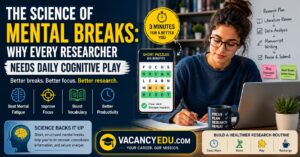
Wendplay or Wend Game is a daily word puzzle that takes just a few minutes to complete, with beginner, intermediate, and expert grid sizes that add a bit of increasing challenge without demanding a big time commitment.
It works on both desktop and mobile, requires no account to start playing, and is easy to pause and resume if a lab experiment or meeting interrupts you mid-puzzle. If you’re curious afterward, daily answers are available to check your work. Most importantly, it has a clear completion state – there’s no infinite feed, no unlockable next level, no algorithm trying to keep you scrolling.
That makes it a natural fit for moments like:
- Before starting a writing session
- During a coffee break
- Between lab experiments
- While waiting for code to finish running
- Right after submitting a manuscript draft
If you’re looking for a healthier alternative to doomscrolling between writing sessions, a quick daily puzzle at WendGames can become a simple, low-pressure part of your research routine.
Building a Sustainable Research Routine
A few small, repeatable habits tend to matter more than any single big change:
- Protect the first hour of your morning for deep work
- Silence notifications during focused sessions
- Batch emails instead of checking constantly
- Schedule deliberate breaks instead of waiting until you’re already drained
- Move your body at least once every hour
- Include one short cognitive activity during longer work blocks
- Celebrate small daily wins, even the boring ones
None of these require a lifestyle overhaul. Small routines are far easier to sustain than dramatic ones, especially during a PhD or postdoc, when your schedule already feels like it belongs to someone else.
Conclusion: Protect Your Most Valuable Research Tool
Research success isn’t only about intelligence. It’s about sustaining focus and motivation over months and years of writing, revising, and applying.
Protecting your mental energy deserves the same attention you give your CV or your next submission deadline. Small, intentional cognitive breaks can improve focus, reduce mental fatigue, and make long writing sessions genuinely more sustainable — not just easier to survive, but easier to do well.
Whether you’re deep in a PhD program, navigating postdoc applications, or preparing for a faculty interview, your brain deserves a real break now and then, not just a different screen.
Your research career is built one focused hour at a time. Protecting your attention isn’t a luxury – it’s part of becoming a better scientist. Whether your cognitive break is a walk, a stretch, or a three-minute word puzzle on Wend Game, make it intentional. Your next breakthrough may depend not only on how hard you work, but on how well you recover.
Sources referenced in this article:
- Mark, G., Gudith, D., & Klocke, U. — University of California, Irvine — “The Cost of Interrupted Work: More Speed and Stress”
- American Psychological Association — “Multitasking: Switching Costs”
- Nature Reviews Neuroscience — Replay, the default mode network, and the cascaded memory systems model
- PMC (National Institutes of Health) — Social media use and social anxiety in college students, mediation effect of communication capacity
- ScienceDirect (Elsevier) — Systematic review on social media use, social anxiety, and loneliness
- BMC Medical Education — Scoping review on the Pomodoro Technique in academic study
- Nature (Humanities and Social Sciences Communications) — Meta-analysis of the Zeigarnik and Ovsiankina effects
- PMC (National Institutes of Health) — Gamification in EFL/ESL instruction: a systematic review of empirical research
Related Posts
- Polite Follow-Up Email to Professor : When and How You should Write

- Online PhD Programs: Pros and Cons, Universities, Courses, Career.
- Top Websites to Create and Download Free Resume Templates
- Top 25 Free Statistical Analysis Software 2024
- What is a letter of intent (LOI)? Meaning with Sample
- PhD in Psychology : Career, Admission Process, Benefits, Opportunities.
- What is PhD : Meaning, How to Do, Benefits, Full Details
- How to Write a Motivation Letter for PhD, Postdoc, or Any Position: Sample Motivation Letter
- How to increase Brain Power – Secrets of Brain Unlocked
- Postdoc Application Cover Letter Template
- How to write a Postdoc Job Application or Email
- How to Write a Curriculum Vitae (CV) for a Job Application
- Five Steps of Writing a Great Resume
- How to Write an Effective Cover Letter